
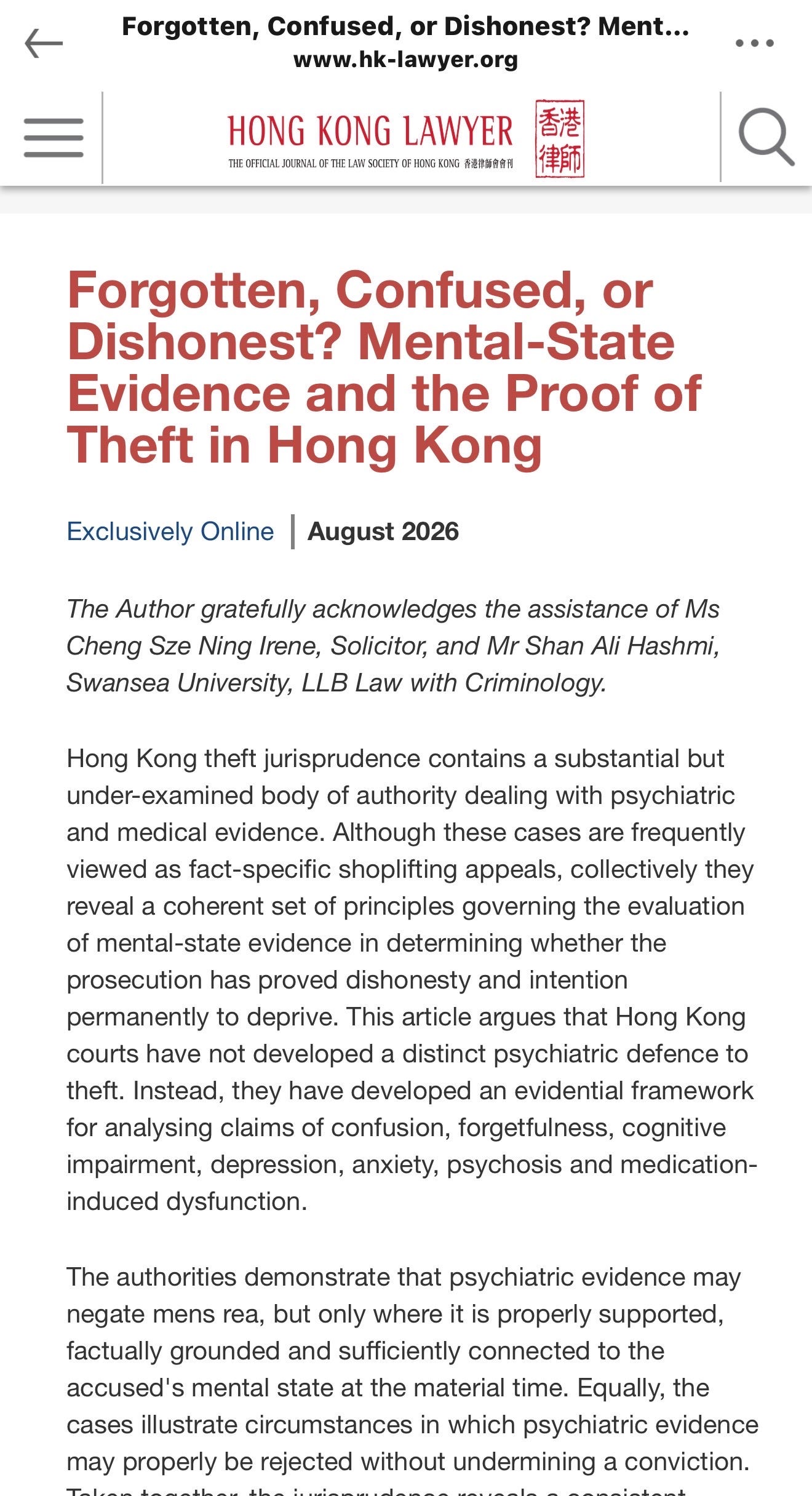
The article examines a substantial but underexamined body of Hong Kong authority on psychiatric and medical evidence. It argues that Hong Kong Courts have not developed a distinct psychiatric defence to theft. Instead, they have developed an evidential framework for analysing claims of confusion, forgetfulness, cognitive impairment, depression, anxiety, psychosis and medication-induced dysfunction.
The authorities demonstrate that psychiatric evidence may negate mens rea, but only where it is properly supported, factually grounded and sufficiently connected to the accused’s mental state at the material time. Equally, the cases illustrate circumstances in which psychiatric evidence may properly be rejected without undermining a conviction. Taken together, the jurisprudence reveals a consistent concern with proof rather than excuse and with evidential reliability rather than diagnostic labels.
Drawing together authorities spanning almost three decades, the article argues that the cases collectively reveal a coherent structure organised around three recurring inquiries: whether the accused was genuinely forgotten, whether the accused was genuinely confused, or whether the evidence nevertheless establishes dishonesty.
Ultimately, the resulting jurisprudence does not ask whether an accused is mentally ill. It asks a more precise legal question: whether the evidence establishes beyond reasonable doubt that the accused acted dishonestly and with the intention permanently to deprive. The Courts’ concern is neither diagnosis nor excuse, but proof.
The article is now available online:
Thanks to Hong Kong Lawyer / Thomson Reuters for publishing this piece.
Thanks to Ms Irene Cheng , Solicitor, and Mr Shan Hashmi, Swansea University / Prifysgol Abertawe, LLB Law with Criminology for their assistance.
#HKLawyer #CriminalLaw #HongKongLaw #MensRea #Evidence #Theft #MentalHealthLaw #LegalWriting #Litigation #HongKongLegalProfessionion